Triplicane has always been a center of culture, education, and social reform. In the 1840s and 1850s, the community’s vision for education led to the founding of two small schools. one for Tamil boys (Dravida Patasala) and another for Telugu boys (Hindu Andhra Balura Patasala). By 1852, both schools were functioning with dedicated teachers and enthusiastic learners. Subjects such as Tamil classics, History, Geography, Arithmetic, and English were taught, with examinations conducted by external examiners.
Early Administration and Governance
Each school had its own Committee of Management composed of local subscribers who contributed monthly. Those who defaulted on payments were first reminded gently and then removed if arrears continued.
The Tamil School Committee met regularly every month, recording proceedings in Tamil but corresponding with the Government in English. an early example of bilingual administration. To ensure transparency, the Committee even maintained an account in the Post Office Savings Bank. Teachers were carefully selected after thorough inquiries into their character and ability.
Financial assistance came partly through Government grants-in-aid and Pachiappa’s Charities, helping sustain operations in those formative years.

Both schools were initially run by separate committees formed by local residents. Members contributed monthly subscriptions, managed funds responsibly, and even kept transparent records in English while conducting proceedings in Tamil. To ensure quality, teachers were carefully selected, and finances were supplemented by government grants-in-aid and support from Pachaiyappa’s Charities.

As both the Tamil and Telugu schools grew in popularity, maintaining them separately soon became a financial strain on the community. Many well-wishers who supported both institutions realized that sustaining two schools with limited funds and donations was difficult. In response to this challenge, a bold and progressive step was taken. the two schools were formally amalgamated on 1st February 1860.

Teachers in those days worked for meager salaries, reflecting the limited financial resources. Yet, their dedication made the school flourish. By the 1870s, under the leadership of M.A. Singarachariar, the school expanded into Matriculation classes and sent its first batch of students for public examinations in 1870. His tireless service for over 38 years transformed the institution’s stability and reputation.
During the late 19th century, the Boys’ School faced stiff competition from the Presidency College High School and financial hardships. For a brief period, even the Matriculation class was closed, and the Committee considered limiting instruction to the Primary level.
However, the tide turned when the High School Department of Presidency College was abolished, allowing the Triplicane Anglo-Vernacular High School to thrive once again.
By the end of 1868, the schools faced a severe decline — the Boys’ School had only 48 students and finances showed a deficit of Rs. 80. At this critical juncture, Mr. M.A. Singarachariar, Head Cashier of the Bank of Madras, was invited to take over as Secretary and Treasurer.
With remarkable devotion, he personally cleared the school’s debts and restored stability. Under his leadership, the school regained strength, popularity, and financial soundness. His tireless service for over 38 years as Secretary, Member, and President earned him the title of the school’s guiding spirit.
From its humble beginnings as two small schools in Triplicane, Hindu High School grew into one of the most respected institutions in South India. Its legacy is built on:
Today, the school continues to stand as a living memorial to its founders, benefactors, and visionaries who shaped generations of students for over 150 years.
In 1908, the school suffered a great loss with the passing of Mr. M.A. Singarachariar. As a tribute, the Singarachariar Hall was established in his memory, inaugurated by Sir John Wallis, Chief Justice of Madras. This hall remains a symbol of gratitude to the man whose vision shaped the school’s destiny.
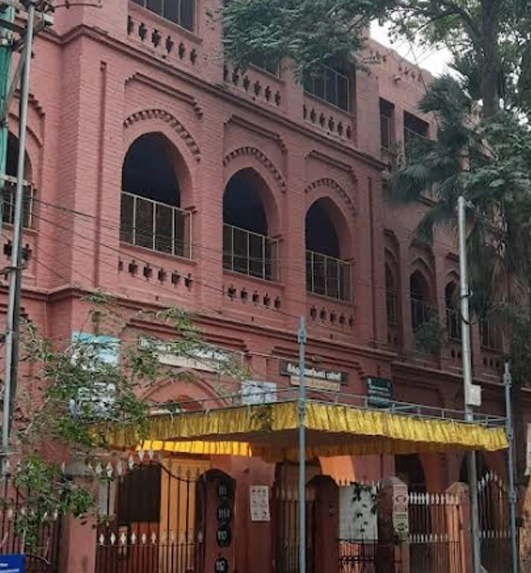
despite the Government’s suspension of grants-in-aid in 1885 due to inadequate accommodation, the Managing Committee remained undaunted. Through public support and personal sacrifice, they purchased land and began construction of a magnificent main building.
The project cost Rs. 57,627, with Rs. 19,209 contributed by the Government and the rest raised through savings and donations. The construction was entrusted to the distinguished contractor Mr. T. Namberumal Chettiar.
The new building was inaugurated on 12th March 1898 by His Excellency Sir Arthur Havelock, Governor of Madras, in the presence of eminent dignitaries. Following this event, the institution was officially renamed “The Hindu High School, Triplicane.”
Post Independence Expansion and Centenary Vision
By the late 1940s, rising student numbers led to the adoption of a shift system due to lack of space. The Government of Madras eventually approved land acquisitions in 1949–1950, providing grants to support the school’s expansion.
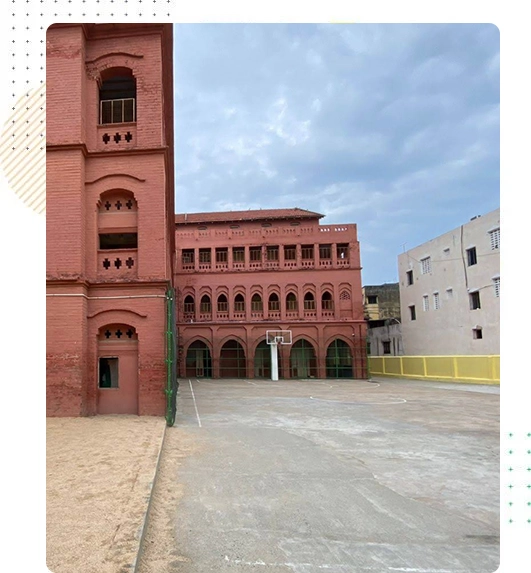
In preparation for its Centenary Celebrations (1951–1952), the Committee launched an ambitious plan to construct a three-storeyed building with 24 classrooms. The ground floor was completed by December 1953, and efforts continued to raise the remaining floors.
The appeal for contributions from alumni and well-wishers reflected the enduring community spirit that has always defined The Hindu High School, Triplicane.