
Inauguration of New Building
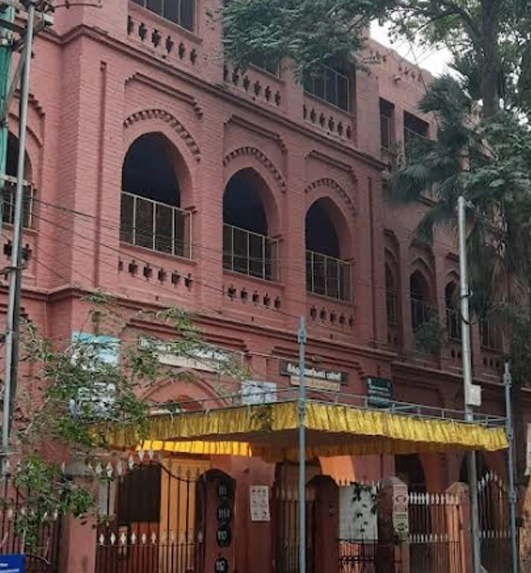
On the afternoon of Saturday, the 12th March 1898, His Excellency Sir Arthur Havelock, the Governor, opened the new buildings of the Hindu High School in Veeraraghava Mudali Street, Triplicane. A few minutes after 4 p.m. His Excellency the Governor, accompanied by Mr. H. A. Sim and Captain Logan Home, arrived, and was received by the members of the Managing Committee of the School, consisting of Rajah T. Rama Rao, Mr.M.O.Parthasarathy Aiyangar, Mr.M.Veersaraghavachariar, Mr.M.A.Singarachariar, and Mr.M.A.Tirunarayanachariar, and conducted upstairs. On His Excellency taking his seat on the dais, Mr. M.O. Parthasarathy Aiyangar, Secretary, read

THE COMMITTEE OF THE HINDU HIGH SCHOOL AND THE ANGLO-VERNACULAR PRIMARY SCHOOL
- Hon'ble Raja T. Rama Rao . . President
- M. Veeraraghavachariar Other Member
- M. A. Slngarachariar . . Other Member
- M. 0. Parthasarathy Iyengar .. Secretary
- M. A. Tirunarayanachariar . . Asst. Secretary
TEACHING STAFF
| Teaching Staff List |
|---|
|
S. Purnapregna Rao, M.A. .. (Headmaster) |
|
T. A. Swamijiatha Aiyar, B.A. .. (Asst. Master) |
|
M. K. Srinivasa Aiyar, B.A. .. (Asst. Master) |
|
K. S. Krishnamachariar . . (Asst. Master) |
|
M. M. C. Narasimhachariar .. (Asst. Master) |
|
B. Narasinga Rao .. (Asst. Master) |
|
T. C. Krishnamachariar, B.A. .. (Asst. Master) |
|
A. Subramania kyar, B.A. .. (Asst. Master) |
|
N. R. Nagojee Rao, B.A. .. (Asst. Master) |
|
T. E. Venkatachariar .. (Asst. Master) |
|
C. Raghavalu Naidu .. (Asst. Master) |
|
R. Ranganadliachar, B.A. .. (Asst. Master) |
|
P. N. Srinivasa Aiyar .. (Asst. Master) |
|
U. C. Doraiswami Iyengar, B.A. .. (Asst. Master) |
|
C. S. Narayanamoorthi Pant .. (Asst. Master) |
|
T. Raghavachariar .. (Head Tamil Pandit) |
|
S. Ramaswami lyangar . . (Asst) |
|
W. Tiruvenkatachariar . . (Telugu Pandit) |
|
P. K. Doraiswarni Iyengar ., (Sanskrit Pandit) |
|
S. R. Subrarmania Iyer .. (Librarian & Gymnastic Instructor) |
|
M. Venkataswami Naidu .. (Drawing Master) |
|
T. A. Parthasarathy Iyengar .. (Clerk) |
Teaching Staff in the A. V. Primary School
- C. Muniswami Naidu .. Headmaster
- R. Venkatachela Chettar .. Asst Master
- T. S. Viswanatha Iyer
- T. Ramanujachanar
- B. Snpati Rao
- M. Srinivasa Iyengar
- D. Lakshmana Rao
- R. Tirunarayanacharyar
- C. Aiyadorai MudaBar
- M. Varadachariar
- G. Ramachandra Rao
- V. Venkatachela MudaHar
- S. RamaswamiIyengar .. TamI Pandt
- T. A, Parthasarathy Iyengar
Academic Excellence and Recognition
Throughout its history, the school maintained a record of academic excellence. Students consistently achieved outstanding results in Matriculation and Lower Secondary Examinations, securing top ranks and honors. Many alumni distinguished themselves across various professional fields, carrying forward the legacy of their alma mater.
Origins of the Institution
The origins of the school date back over half a century to two early Patasalas or vernacular schools
-
Hindu Andhra Balura Patasala, focusing on Telugu instruction, and
-
Dravida Patasala, emphasizing Tamil.
These two were later amalgamated as the Hindu Andhra Dravida Balura Patasala, under the leadership of P. T. Ramanjootoo Naidu, Head Translator of the High Court (President), and Devanayaga Mudaliar (Secretary).
By 5th February 1869, the schools had declined, with only 36 students and a financial deficit of Rs. 80. At this critical juncture, Mr. M. A. Singarachariar, Head Cashier of the Bank of Madras, took charge as Secretary. His dedication and personal financial sacrifices revived the institution. a contribution so significant that the school became popularly known as “Singarachariar’s School.”
Challenges and Infrastructure Development
Despite its success, the school faced financial challenges. In 1885,
Determined to improve, the Committee purchased:
The present site for Rs. 3,000, and
An adjacent building for Rs. 5,250.
Construction of a new building commenced soon after, estimated at Rs. 57,627. Through Dr. Duncan, Director of Public Instruction, a Government grant of Rs. 19,209 was sanctioned. With Rs. 16,000 from school funds and further public support, construction began under Mr. T. Namberumal Chettiar, an esteemed contractor.
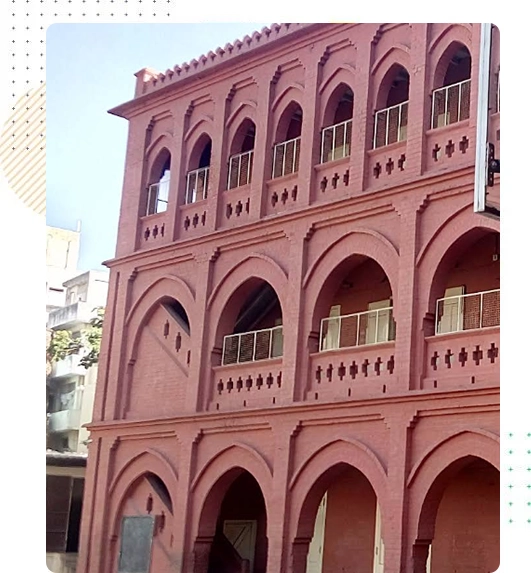
The foundation stone was laid by Dr. and Mrs. Duncan on 11th August 1891, and the building was completed in 1898.
Growth and Evolution
Under Mr. Singarachariar’s leadership, the English section expanded, and the school reached the Matriculation standard in 1870. With these advancements, the school name evolved:
- First to Balura Patasala,
- Then in 1873, to Triplicane Anglo-Vernacular High School
- as suggested by the Director of Public Instruction.
By 1876, the High School was relocated to the present buildings. With the increasing student strength, the Primary Department was shifted to a separate campus, housing nearly 500 students. The Girls’ School (Balika Patasala), which also thrived, came under the patronage of His Highness, the Maharaja of Vizianagaram.
Despite facing competition from the Presidency College High School, the Triplicane institution persevered. When the rival institution’s High School Department was closed, Triplicane Anglo-Vernacular High School regained strength and stability. By 1898, it had nearly 500 students, including 100 in Matriculation classes.
Academic Excellence and Recognition
Throughout its history, the school maintained a record of academic excellence. Students consistently achieved outstanding results in Matriculation and Lower Secondary Examinations, securing top ranks and honors. Many alumni distinguished themselves across various professional fields, carrying forward the legacy of their alma mater.
The Committee emphasized the appointment of capable teachers and headmasters, ensuring high academic standards. A new library, lauded by Mr. Marsden, Inspector of Schools.
Leadership and Administration
Around 1880, Mr. Singarachariar handed over the Secretaryship to Mr. M. D. Gopalachariar, Manager of the High Court, though he remained an active committee member. Upon Gopalachariar’s death in 1887, Singarachariar briefly resumed office until Mr. M. O. Parthasarathy Iyengar assumed the role.
- Mr. M. Veeraraghavachariar, Proprietor of The Hindu (joined 1889)
- Mr. M. A. Tirunarayanachariar, Vakil of the High Court (joined 1896)
On the recommendation of the Director of Public Instruction, the school was officially renamed The Hindu High School, Triplicane . a name it proudly retains to this day.

Architectural Highlights
The newly constructed school building consisted of:
Two main blocks — the rear (three-storey) and the front (two-storey, with provision for a third).
The ground floor had six classrooms (24 ft × 20 ft × 13 ft) for 40 students each.
The upper floor housed a spacious hall (71 ft × 43 ft) with verandahs on all sides.
The rear block contained additional classrooms and a science laboratory.
The total cost was approximately Rs. 45,000, considered highly economical for its size and quality.